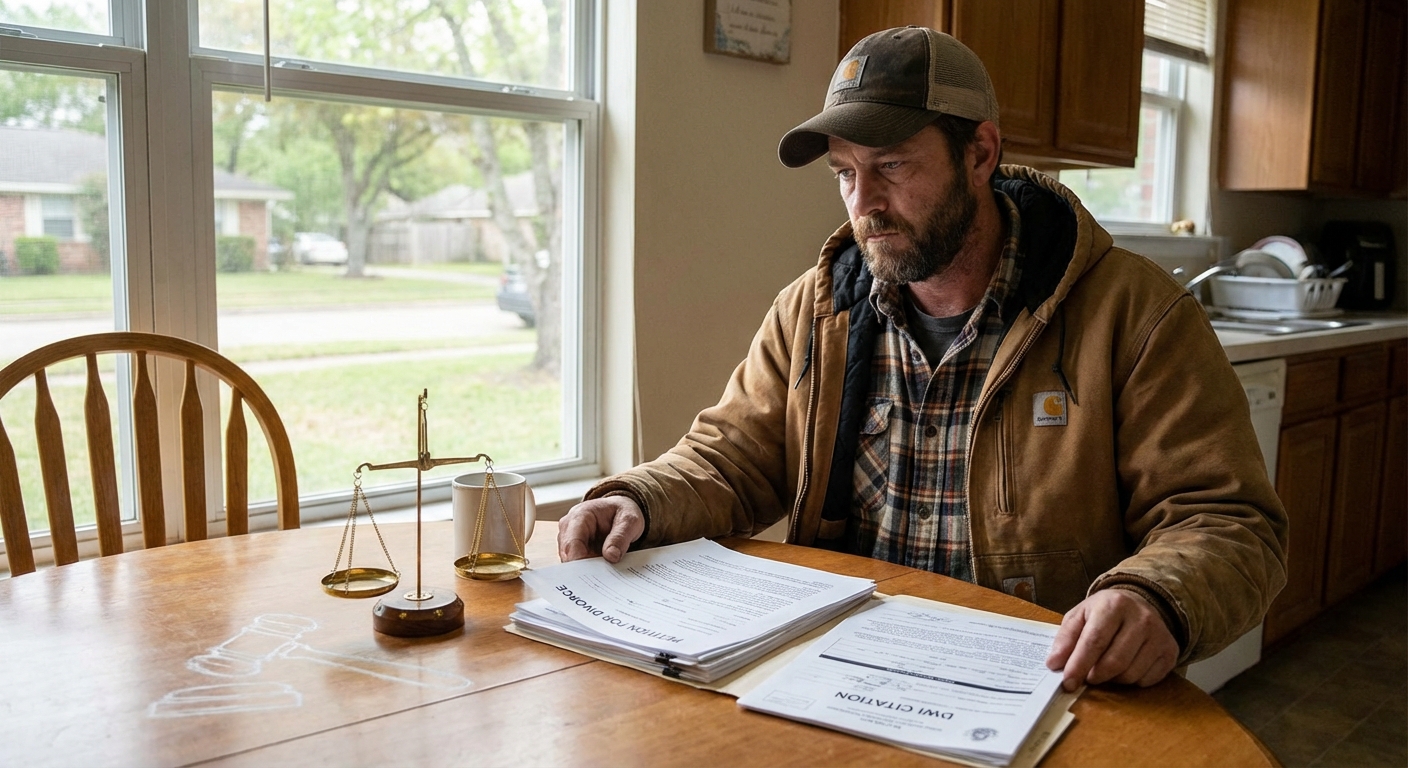
Divorce & DWI: Can a DWI Impact Divorce Settlements in Texas?
Yes, a DWI in Texas can impact divorce settlements, especially when it touches child custody, visitation, support, and your ability to keep working and driving. A single arrest or conviction will not automatically ruin your divorce, but it can give the other side arguments about your judgment, safety, and finances if it is not handled carefully. Understanding how criminal and family courts interact is the first step to protecting your kids, income, and long term future.
If you are a family focused provider in the middle of a Houston or Harris County divorce, it is natural to worry that one DWI mistake will cost you time with your children, raise alimony or child support, and drain the assets you worked hard to build. This guide walks through how Texas courts look at DWIs during divorce, what is myth versus reality, and what practical steps can help reduce the damage.
First things first: what a DWI is under Texas law and why it matters in divorce
Before you can see how a DWI plays into divorce, it helps to know what the criminal case actually involves. In Texas, a DWI is usually charged when a driver is at or above a 0.08 BAC, or when the officer claims the person lost the normal use of their mental or physical faculties because of alcohol or drugs. Even a first time DWI can lead to fines, license suspension, and a criminal record that a family court judge may see during a divorce.
If you are still getting your bearings, this plain explanation of DWI basics and penalties can help you understand the charges and possible outcomes in simple terms. For someone already stressed by a divorce, clearing up the basics makes it easier to focus on your next decisions.
For Tyler the Young Unaware, the key point is simple: a DWI is a criminal case about driving after drinking or using drugs, and it can lead to a record, fines, and license issues that your divorce judge is allowed to consider.
How a Texas DWI can affect child custody and visitation
When you share children, this is usually the biggest fear. You may be imagining supervised visitation, losing overnight time, or a judge assuming you are a bad parent because of one arrest. In reality, family courts in Houston and surrounding counties focus on a single standard: the best interest of the child.
That means judges look at patterns more than one isolated event. Still, a DWI can be used by the other parent to argue that you have a substance abuse issue or poor judgment. It is especially serious if the allegation involves:
- A high BAC result
- A repeat DWI or prior alcohol related offenses
- A crash with injuries or property damage
- A child in the vehicle at the time of the arrest
If any of these factors are present, your spouse and their attorney may push for limited visitation, alcohol testing, or restrictions on driving the children. Courts sometimes order conditions like no drinking within a certain number of hours before visitation, or using ignition interlock devices.
If you want a deeper dive on custody issues, this guide explains how courts consider DWIs in custody decisions and what judges look for when deciding whether a parent is a safe and stable caregiver.
For a construction manager in his mid 30s, the judge will pay close attention to whether you can show up sober, on time, and consistently for your kids. Attending work reliably, completing any ordered classes, and following bond conditions can all help signal that the DWI was a wake up call, not an ongoing risk.
Elena the Nurse: if you work irregular shifts and worry about both licensure and child care, a DWI can raise extra questions about fatigue, stress, and chemical dependency. Showing that you completed evaluations, counseling, or monitoring can reassure both your licensing board and the family court that you are taking safety seriously at work and at home.
How does a DWI affect alimony and child support payments?
Many people ask: how does a DWI affect alimony and child support payments in Texas? The short answer is that a DWI does not directly raise or lower support numbers, but the financial fallout around it can change what you pay or receive.
Texas child support is usually based on guideline percentages of your net resources. If your license suspension or a criminal conviction causes you to lose job opportunities or overtime, your income can drop. The court might impute income if it believes you are under earning on purpose, but if the drop is real and documented, support can sometimes be adjusted.
On the other hand, if your DWI leads to big fines, fees, and higher insurance, that alone does not reduce your support obligations. Family courts typically treat those as consequences of your own choices, not a reason to shift more financial burden onto the other parent.
Spousal maintenance in Texas is more limited than in some states, but a DWI can still play a role. For example:
- If your spouse claims they need more support because of your unstable income after a DWI conviction, the court may listen carefully to that evidence.
- If you argue you cannot afford maintenance because of DWI related costs, the judge may give that little weight, especially if you are otherwise employable.
For Daniel the Analyst, studies and case outcomes show that the bigger drivers of support changes are income shifts and employability, not the label of DWI alone. Courts focus on pay stubs, work history, and realistic earning capacity, then consider the DWI as one factor within that picture.
Property division, debts, and DWI related spending
Texas is a community property state, which means that during divorce most assets and debts acquired during marriage are divided in a way that is considered just and right. A common misconception is that every community estate is split 50/50 no matter what. In reality, judges can adjust the division when there are reasons to do so, including fault, waste of assets, or serious misconduct.
So can a spouse use a DWI as evidence for a divorce case when arguing for a larger share of property or protection from debts? Sometimes yes. A DWI can be used to argue that you wasted marital funds on:
- Fines and court costs
- DWI education or treatment programs
- Vehicle repairs or higher insurance after a crash
- Criminal defense fees, especially if unusually high
If your spouse can show that large community funds were spent connected to alcohol related behavior or a DWI crash, they may ask the court to compensate them by awarding them a slightly larger share of remaining assets. The judge has broad discretion, especially if this is part of a bigger pattern of alcohol abuse or risky spending.
On the other side, if you are the lower earning spouse and your partner has a serious alcohol issue, your family lawyer may argue that their DWI conviction shows instability that justifies extra financial protection for you and the children. The same facts can be used in more than one way, which is why strategy and documentation matter.
For Sophia the Executive, this is also where reputation and speed matter. Quietly resolving the criminal case, documenting any treatment or counseling, and negotiating property terms that fairly allocate DWI related debts can protect both your public image and your long term net worth.
License suspension, ALR, and why the first 15 days matter
Your right to drive is often the most urgent issue when you are trying to keep a job, move between job sites, and handle parenting time. After a Texas DWI arrest, a separate civil process called Administrative License Revocation (ALR) kicks in. You usually have 15 days from the date you receive the notice of suspension to request an ALR hearing, or your license can be automatically suspended for a period that might range from 90 days to 2 years depending on your history and whether you refused testing.
To see the official rules and timeframes, you can review the Texas DPS overview of the ALR license-suspension process. Understanding this civil track helps you plan around work and visitation while the criminal and divorce cases are still moving.
For someone in construction who must drive to sites, losing your license in the middle of a divorce can hurt your income and your ability to exercise parenting time. That is why it is critical to understand how ALR/15‑day deadlines affect your license and whether you can request an occupational license that lets you drive for work and essential household needs.
If a judge sees that you made no effort to preserve your driving privileges and repeatedly missed parenting exchanges, that can influence custody decisions. Acting promptly to manage the license issue shows responsibility, even after a mistake.
Does a DWI increase legal costs in a divorce case?
Yes, a DWI almost always increases legal costs around a divorce, although how much depends on the facts, whether there was a crash, and whether children or serious injuries were involved. You are suddenly paying for two separate legal tracks: the criminal case and the family case. Each may require court appearances, expert evaluations, and time off work.
Additional costs can include:
- Criminal defense fees
- Court fines and probation fees
- Alcohol monitoring devices or ignition interlock
- Substance abuse assessments or counseling
- Higher auto insurance premiums
- Lost wages for hearings and license issues
On the family side, your divorce might become more contested if your spouse uses the DWI as leverage, which can lead to extra discovery, depositions, and hearings, all of which add to attorney fees on both sides. A helpful resource on the broader financial impact is this overview of typical divorce‑related legal and financial DWI costs, which shows how fast these expenses can multiply in the Houston area.
For a provider trying to keep the family afloat, the goal is usually to contain damage. Early planning about payment, documenting all DWI related expenses, and budgeting around potential fines or classes can keep your divorce from stalling because bills are piling up.
Can a DWI cause a judge to change a divorce ruling?
Sometimes the DWI comes after temporary orders are already in place, or even after a final divorce decree. So can a DWI cause a judge to change a divorce ruling in Texas? It depends on timing and what, exactly, you want to change.
In general:
- Custody and visitation can be modified when there is a material and substantial change in circumstances that affects the best interest of the child. A new DWI, especially one involving a child passenger or serious crash, can meet that standard.
- Child support can also be modified if your income changes significantly and the guidelines would differ by a certain amount. Job loss or a long jail sentence could trigger this, although courts look closely at whether the change is voluntary.
- Property division is usually final once the decree is signed and deadlines pass. A later DWI usually does not reopen the property split itself, but unpaid DWI related debts can still affect both parties in practical ways.
The key point is that new criminal charges or convictions can give either side an opening to ask the court to revisit custody or support. If you are the parent with the DWI, it is important to address safety concerns head on and show steps you are taking to prevent a repeat.
How spouses try to use a DWI as evidence in divorce cases
When emotions run high, it is common for one spouse to treat the DWI as the centerpiece of the divorce case. They may try to use it to paint you as irresponsible, dishonest, or unsafe. Typical tactics include:
- Introducing police reports, BAC results, and dashcam footage to question your judgment
- Calling officers or witnesses to describe the arrest, especially if there was a crash
- Arguing that the DWI is part of a longer pattern of drinking or drug use
- Pointing to license suspension as proof you cannot reliably transport the children
For you, this can feel like one bad night is being stretched into a story about your entire character. A realistic approach is to separate what is factually accurate from what is being exaggerated. Challenging unreliable test results, clarifying the exact location of the children at the time, and showing a stable work history can all help keep the DWI in perspective.
For Daniel the Analyst, it may help to think in terms of probabilities. A clean prior record, no crash, no child in the car, and quick compliance with court conditions generally reduce the chance that a DWI will completely derail custody or property outcomes, though every case is unique. On the other hand, repeat DWIs or cases with serious injuries significantly increase the risk of stricter orders.
Record status, nondisclosure, and what divorce courts can still see
Even after the criminal case is over, the record can continue to affect your divorce, job, and reputation. In Texas, certain DWI misdemeanors may qualify for nondisclosure, which seals the record from most public background checks but not from law enforcement or many government entities. Nondisclosure is not the same as expungement, and there are waiting periods and eligibility limits.
To understand the legal framework, it helps to review the Texas statute on nondisclosure for certain DWI offenses, which explains who may qualify, how long they must wait, and which agencies can still access the information. Even with nondisclosure, a family court may still learn about the DWI through direct questioning, disclosures from the parties, or law enforcement records when safety is at issue.
In practice, nondisclosure can still be useful during and after divorce, because it limits what employers and many private background check services can see. For a provider supporting a family, that can make a big difference in keeping and advancing in your job.
Micro story: how one Houston DWI echoed through a divorce
Consider a composite example drawn from typical Harris County situations. A 36 year old construction foreman was going through a contested divorce with two young children. After a birthday party, he was stopped and charged with a first time DWI. His BAC was just over the legal limit, and no one was hurt, but his license was at risk and his spouse was furious.
The spouse immediately asked the family court to change temporary orders: supervised visits, no overnights, and a ban on driving the children. The court scheduled a hearing. In the meantime, the father requested an ALR hearing within the 15 day window and obtained an occupational license so he could keep working. He completed a substance abuse evaluation and started recommended counseling.
At the custody hearing, the judge reviewed the arrest, asked about prior history, and focused on the children. Because there was no accident, no kids in the car, and active steps to address the situation, the court chose not to impose supervised visitation. Instead, the judge added conditions: no alcohol during possession and proof of continued counseling. The divorce still took longer and cost more, but his relationship with his kids stayed mostly intact.
This type of outcome is never guaranteed, but it shows how proactive steps and honest follow through can limit the damage from a single mistake.
Common misconception: “If it is my first DWI, the divorce judge will ignore it”
A frequent misconception is that a first DWI in Texas is a minor issue that family judges will simply overlook. While some judges may give less weight to a low BAC, no crash, first offense, they almost never ignore it. They may ask questions about your drinking habits, driving, and mental health. They might order evaluations or impose alcohol related conditions on visitation.
The better mindset is to assume the DWI will come up and prepare to answer for it. That means gathering proof of steady work, clean random tests if ordered, counseling attendance, and positive involvement in your kids lives. Treating the incident as serious, even if it seems routine on the criminal side, can help you hold onto the parenting role you value.
Mitigation options: how to limit DWI damage in a Texas divorce
While no article can give you case specific advice, there are common mitigation steps that often help when divorce and DWI overlap.
1. Address safety concerns directly
If your spouse is raising safety fears, judges want to see action, not just words. Depending on your situation, that could include:
- Completing a substance abuse evaluation and any recommended treatment
- Attending alcohol education classes
- Agreeing to reasonable sobriety conditions during parenting time
- Installing ignition interlock if recommended
These steps do not admit guilt in the criminal sense, but they show the family court that your priority is your children, not your pride.
2. Protect your work and driving ability
Because child support and alimony are tied to your ability to earn, keeping your job and managing license issues is critical. That may mean carefully planning court dates, asking about occupational licenses, and documenting any work schedule changes so the court sees that you are still doing your best to support your family.
For Elena the Nurse and others with professional licenses, you may also need to self report or respond to board inquiries. Prompt compliance, letters from supervisors, and proof that patient care has never been compromised can help you show both the board and the family court that your license and job are stable.
3. Get clear on the evidence and possible outcomes
Understanding the strength of the DWI case can directly affect divorce strategy. If the BAC test is questionable, the stop may be challengeable, or the state is willing to reduce or dismiss charges, that can change how much weight the divorce court should give the arrest. On the other hand, if there is video of dangerous driving with a child in the car, expecting the issue to be minor is unrealistic.
Some readers like Daniel the Analyst prefer to think in scenarios: best case, likely case, and worst case. Mapping those out for both the criminal and family cases can clarify which battles are worth fighting and where compromise makes sense.
4. Explore nondisclosure and record sealing options
In the medium and long term, considering nondisclosure or other record relief can protect your ability to work and support your kids. It is important to know that not all DWI cases qualify, and that even with nondisclosure, certain agencies and courts can still access the records. Still, for many parents, being able to pass most employer background checks without a visible DWI is a major step toward stability.
5. Use questions and resources to stay informed
Many people in your position feel overwhelmed trying to juggle criminal deadlines, family hearings, and daily life. Using an interactive Q&A resource for common DWI questions can help you organize what to ask your own attorney and what documents to gather before important meetings or hearings.
Whether you are the one charged with DWI or the spouse worried about safety, focusing on clear information and concrete steps usually reduces stress and leads to better long term decisions.
Key FAQs about “Can a DWI impact divorce settlements?” under Texas law
Can a DWI impact divorce settlements even if it is my first offense in Texas?
Yes, a first DWI in Texas can still impact divorce settlements, especially in areas like child custody, visitation, and how judges view your judgment and reliability. Courts may order alcohol related conditions, evaluations, or testing even on a first offense. The impact is usually greater if there was a crash, a high BAC, or a child in the car.
How does a DWI affect alimony and child support payments in a Houston divorce?
A DWI affects alimony and child support indirectly, through your income and employability. If you lose a job or significant hours because of a DWI conviction, you may be able to ask to adjust support, but courts look closely at whether the change is temporary or self inflicted. Extra DWI related expenses by themselves usually do not reduce support obligations.
Can a new DWI cause a judge to change an existing Texas custody order?
Yes, a new DWI can be grounds to request a modification of custody or visitation in Texas if it represents a material and substantial change that affects the child’s best interest. Judges pay particular attention to DWIs involving crashes, high BAC levels, or children in the vehicle. The court may add conditions, restrict driving, or in serious cases change primary custody.
Does a Texas DWI always increase legal costs in a divorce case?
Almost always, a Texas DWI will increase your overall legal costs because you are dealing with both a criminal case and a family case. You may face additional hearings, evaluations, and time off work, as well as fines and probation fees. Careful planning and early action can help keep those costs from spiraling out of control.
Can a spouse use a past DWI that is under nondisclosure against me in divorce court?
Even if a past DWI is under nondisclosure, certain courts and government entities may still access the record, and your spouse may already know about the incident. While nondisclosure can limit what shows up on many background checks, it does not guarantee that the family court will never hear about the DWI. The court will decide how much weight to give older or resolved incidents in light of current behavior.
Why acting early matters when divorce and DWI collide
When you are juggling a Texas DWI and a divorce, it is easy to feel like everything is coming apart. Yet the choices you make in the first days and weeks after an arrest often shape how much the case affects your kids, your job, and your settlement. Requesting an ALR hearing within the deadline, keeping up with work, and following court instructions show that you are still the steady provider your family depends on.
For the family focused provider, your goal is not perfection but progress. You cannot erase the arrest, but you can show your children, your co parent, and the court that you are taking responsibility and building safer habits. Whether you are most worried about custody, support, or your professional reputation, learning how Texas law treats DWIs in divorce gives you a better chance to protect what matters most.
Staying informed, organized, and proactive, and speaking with a qualified Texas DWI and family law attorney about your specific facts, is usually the most reliable path to a fair outcome that balances accountability with a stable future for your family.
To help you better understand how a DWI appears on your Texas record and what that means for divorce and custody, you may find this short video useful:
Butler Law Firm - The Houston DWI Lawyer
11500 Northwest Fwy #400, Houston, TX 77092
https://www.thehoustondwilawyer.com/
+1 713-236-8744
RGFH+6F Central Northwest, Houston, TX
View on Google Maps
No comments:
Post a Comment