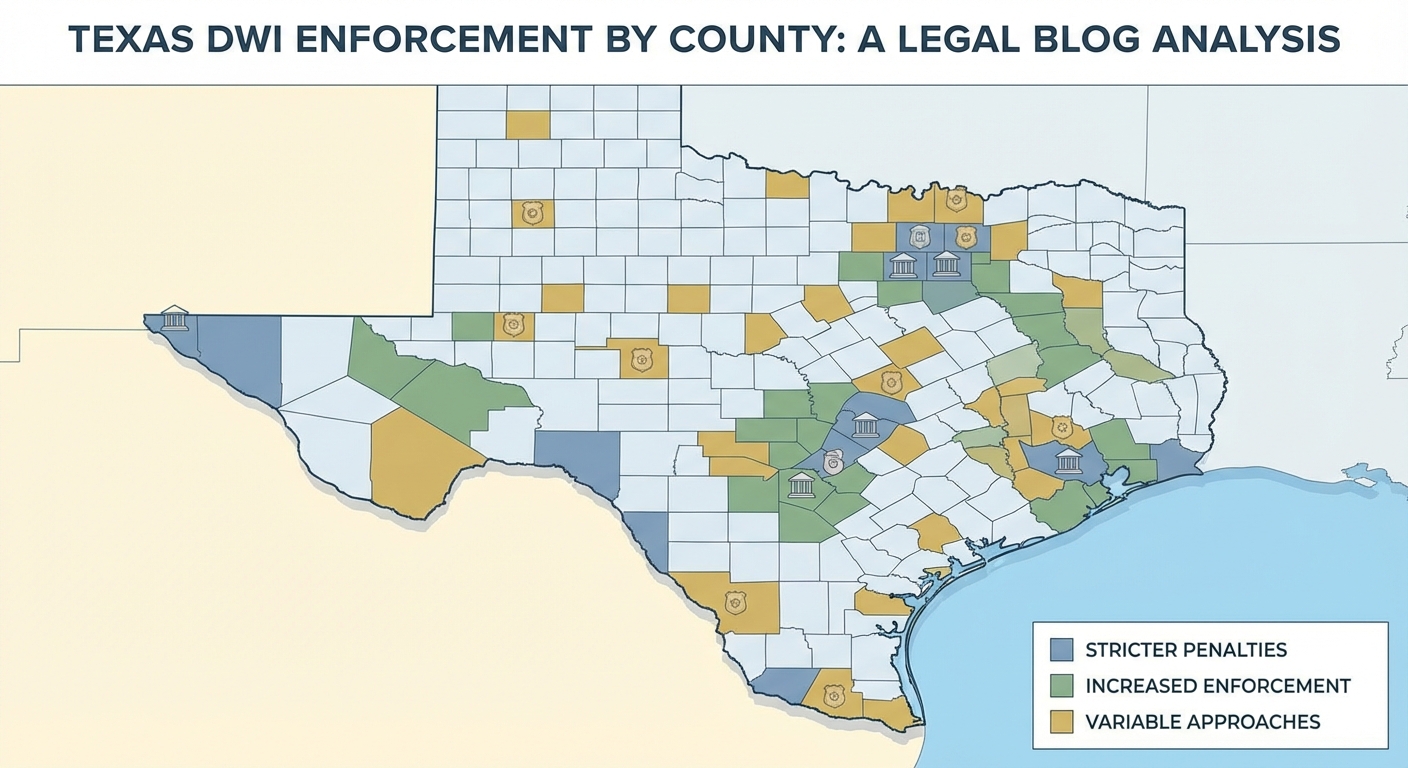
How DWI Laws Differ by County in Texas
In Texas, the DWI statute is the same in every county, but how tough your case feels depends a lot on where you were arrested, and some counties are widely viewed as having the toughest DWI penalties because of how they use their discretion within that statewide law. The maximum fines, jail ranges, and license consequences are set by state law, yet local prosecutors, judges, juries, and probation departments decide how hard to push within those ranges. If you are a working professional trying to compare counties, you are really comparing local enforcement intensity, plea policies, and sentencing culture rather than different written laws.
Put simply, when people ask “Which Texas counties have the toughest DWI penalties?” they are asking which counties are most aggressive in arrests, charging decisions, plea offers, and conditions like ignition interlock, classes, or community service. In the Houston area and across Texas, those differences can be significant, especially if you rely on your license, professional reputation, or security clearance.
Texas DWI law is statewide, but counties apply it very differently
Every DWI in Texas is based on the same statute: driving while intoxicated means having a 0.08 BAC or higher or losing the normal use of mental or physical faculties because of alcohol, drugs, or both. The basic sentencing ranges for a first, second, or felony DWI do not change when you cross a county line. However, how fast you are arrested, whether borderline cases are filed, what plea offers are made, and how often jail time or strict probation is required can look very different in Harris County compared with a rural county two hours away.
If you need a deeper background on the statewide framework before you compare counties, this Texas Penal Code Chapter 49: statutory DWI offenses and penalties resource shows the official, statewide rules that every county works under.
As a location conscious professional, you are likely asking: How much does the county actually change my risk of jail, felony treatment, or long term license consequences? That is a fair concern, especially if your job, professional license, or travel requires a clean record.
Which Texas counties have the toughest DWI penalties in practice?
From a practical standpoint, counties are considered “tough” based on three main factors:
- How aggressively law enforcement makes DWI arrests
- How strict local prosecutors are with plea offers and diversion options
- How often judges or juries hand down the high end of the penalty range
Arrest and conviction data from sources like Texas DPS county-by-agency DWI arrest and disposition data (2024) show that large metropolitan counties like Harris, Dallas, Bexar, and Tarrant generate very high numbers of DWI arrests and prosecutions. High volume does not automatically mean “toughest,” but it usually means:
- Dedicated DWI enforcement units and task forces
- More frequent use of blood draws and advanced testing
- Structured DWI court programs with defined plea grids
In contrast, smaller rural counties may have fewer arrests overall but can still feel harsh because there are fewer negotiated options and fewer specialized treatment courts. A rural judge who sees DWI as a core safety issue may lean toward more jail days or longer probation for repeat offenders.
For a deeper dive on punishment ranges and how counties use them differently, you can review this article that digs into county-by-county sentencing differences and penalty ranges across Texas.
Harris County compared to other Texas counties: what actually changes?
Many people ask directly: “Does Harris County handle DWIs differently than other counties?” The answer is yes, but not because it has different written laws. It is because Harris County has high volume, specialized DWI prosecutors and courts, formal policies for common scenarios, and a long history of handling complex DWI evidence like blood tests, accident reconstruction, and body cam disputes.
In Harris County you are more likely to see:
- Standardized plea policies for first offenders, often tied to BAC level, crash involvement, and prior criminal history
- Specialty DWI court dockets or programs that focus on treatment and monitoring
- Regular use of expert testimony for breath or blood test challenges
By comparison, a nearby smaller county might have fewer specialized DWI dockets, more informal plea bargaining, and less frequent use of advanced testing challenges. Some readers also want to understand how Harris County prosecutes DWI cases differently when it comes to field sobriety tests like HGN and how those tests look on video. That kind of local practice detail can influence whether a borderline case is easier or harder to fight.
If you work in Houston but were arrested in a neighboring county, you need to plan around that county’s culture, not just what you have heard about Harris County. The same blood test in two neighboring counties might lead to very different plea offers or probation terms even though the statute is identical.
Statewide penalties vs county level outcomes
The biggest misconception is that the “toughest” counties must have higher maximum penalties written into law. In reality, the written ranges for a first DWI, second DWI, or felony DWI do not change by county. What changes is where within those ranges your particular court tends to land.
For example, a first DWI in Texas can mean up to 180 days in jail and up to a $2,000 fine in many situations. Some counties routinely structure plea deals around the lower end of that range for first offenders, while others often push for higher fines, longer probation, or stricter license related conditions. For a practical overview of these statewide ranges and how counties usually apply them, you can review this overview of Texas DWI penalties and typical county ranges.
If you are a mid career professional, you may not care as much about the theoretical maximum as you do about realistic best and worst case scenarios in your specific county. Knowing that one county commonly offers non reporting probation for first offenders while another frequently insists on interlock devices and intense supervision can shape your risk assessment and your approach to negotiation.
Are there counties where a DWI is easier to fight?
Some counties have reputations among defense lawyers as “better for trial” or more open minded about scientific disputes. When people ask “Are there counties in Texas where a DWI is easier to fight?” they are usually talking about three things:
- Local juror attitudes toward police stops and blood draws
- How receptive judges are to suppression motions
- How flexible prosecutors are when the evidence is weak or borderline
In high volume counties like Harris County, experienced defense lawyers often know how specific units handle breath machines, blood lab issues, or video inconsistencies. That experience can be leveraged when there are gaps in the stop, field sobriety testing, or chain of custody. In some smaller counties, fewer DWI trials might mean less tested procedures, which can cut either way. Sometimes that creates openings, and sometimes it leads to more conservative rulings.
If you are trying to compare “fightability” between counties, one useful step is to look at how often dismissals, reductions, or acquittals occur compared with total filings, using data such as the DPS DWI reports. Beyond the numbers, understanding how defenses and local practice can change case outcomes will help you avoid relying on simplistic assumptions about “easy” or “hard” counties.
Why are DWI laws stricter in some Texas counties in practice?
When drivers say “laws are stricter” in a specific county, what they normally mean is that the local system has made policy choices that increase the real world impact of a DWI. Common drivers of stricter outcomes include:
- Local history of serious crashes that leads to a political push for tougher sentencing
- Grant funded DWI task forces that focus on weekend or holiday saturation patrols
- Judicial philosophy that prioritizes deterrence and public safety over rehabilitation
- Prosecutor policies that limit reductions or dismissals in certain BAC or crash scenarios
For you as a location conscious professional, the practical question is how these choices translate into your specific exposure. Two coworkers could face a first DWI with a similar BAC but, in a stricter county, one might encounter a tougher plea grid, more required classes, or less room for negotiation.
How rural Texas courts handle DWI cases differently
Many drivers also ask “How does law enforcement in rural Texas handle DWI cases differently?” The answer varies, but some patterns show up across rural counties compared with Houston and other large metro areas.
Rural law enforcement practices
- Fewer officers on patrol means stops may involve a single deputy instead of a full DWI task force
- Roadside testing can be more affected by weather, lighting, and video quality
- Blood draws might require transport to a regional hospital or facility, which can affect timing
Those differences can impact both the strength of the evidence and the practical decisions prosecutors make about marginal cases.
Rural court culture and sentencing
Some rural judges and juries place very high value on community safety and may lean toward visible sanctions, especially for repeat offenders. On the other hand, small communities sometimes allow more individualized consideration of work schedules, family responsibilities, and treatment needs.
If you live in Houston but were arrested in a distant county after a hunting trip or a client visit, you could find yourself in a courthouse where everyone knows each other and DWI has a particular local history. Knowing that context early helps you make better decisions about whether to push for trial, seek a negotiated outcome, or focus on license preservation.
Alternative sentencing options in certain Texas counties
Another common question is “Are there alternative sentencing options in certain Texas counties?” While basic probation, classes, and fines are available statewide, the specific alternative programs offered vary a lot by location.
Examples of county level variations include:
- DWI specialty courts for repeat offenders that focus on intensive supervision and treatment rather than long jail terms
- Pretrial diversion or intervention programs for some first time offenders in select counties
- Electronic monitoring or SCRAM devices as alternatives to extended jail for certain conditions
- Community service based resolutions with targeted education programs
In some larger counties, especially around Houston, these options are clearly defined and applied according to set criteria like BAC level and prior record. In other counties, there may be few or no formal diversion tracks, and informal plea bargaining plays a bigger role. For you, the key is understanding which tools are even on the table in the county where your case is pending.
How county differences affect license suspensions and SR 22
Texas law sets statewide rules for Administrative License Revocation (ALR) and SR 22 insurance requirements. The timeline to request an ALR hearing, usually 15 days after the notice of suspension, is the same regardless of where you were arrested. However, county level differences show up in how aggressively officers seek immediate license suspensions, how often ALR hearings are contested, and what happens if you miss that window.
In higher volume counties, ALR hearings may be more structured, with officers testifying regularly and lawyers challenging reasonable suspicion, probable cause, and refusal issues. In some smaller counties, fewer ALR hearings may lead to different dynamics, including more continuances or less predictable officer attendance.
If you rely on your driver’s license for work, you need a clear roadmap within days of the arrest, not weeks. Waiting to see how things “shake out” can cause you to miss the ALR deadline, which is a statewide rule that does not bend for any county.
Micro story: same charge, different county, very different feel
Consider a mid level project manager who travels between Houston and several smaller Texas counties for work. One weekend he is stopped after a client dinner just outside Harris County and charged with a first DWI. His BAC is only slightly over 0.08, the stop is recorded on clear video, and there was no crash.
In a higher volume county with defined plea grids, he might be offered a standard first offender probation package with classes, fines, and monitoring conditions proportionate to his BAC. The same conduct in a smaller county with a tougher stance might lead to more restrictive conditions, fewer diversion options, or a higher insistence on ignition interlock. In yet another county with a more flexible court culture, the combination of a clean record, borderline BAC, and good video might lead to a more favorable resolution.
This is why professionals often ask about county reputation before they decide how to proceed. The county does not change the statute, but it can change the temperature of your case.
Secondary reader perspectives: how county differences matter to you
Practical Provider (Mike Carter): If you are focused on supporting your family, what you need most is clarity on whether your job and license are at risk and what to do first. The county can change how quickly court dates arrive, how much time you will spend in court, and whether you can keep driving to work during the case.
Specialist Seeker (Ryan/Daniel): If you tend to research heavily, you are probably looking for hard numbers and proof of local experience. That usually means reviewing county level statistics, understanding local court policies, and confirming whether your lawyer regularly handles DWI cases in that specific jurisdiction.
Status Protector (Sophia/Marcus): If you are concerned about discretion and reputation, you may worry about which counties tend to have crowded public dockets or local gossip around courthouse proceedings. In higher volume urban counties, you might blend into a larger docket, while in very small counties, your appearance in court may be more visible in the community.
Unaware Young Driver (Tyler/Kevin): If this is your first serious legal issue, it can be tempting to think a first DWI is “no big deal,” especially if you have friends who were charged in different counties and seemed to get off lightly. The truth is that even a first DWI can carry consequences that affect school, work, and insurance for years, and those consequences can be harsher in certain counties than others.
Careful Clinician (Elena): If you hold a professional license like nursing, pharmacy, or another healthcare field, your concern is often how a DWI in a particular county might look to your board or employer. Boards review the conviction or deferred adjudication itself, not the county name, but a record of harsher facts, repeated probation violations, or extended supervision can raise more questions when you renew or report.
Common misconception: “It is just a first DWI, and this county is pretty lenient”
A frequent misconception among Texas drivers is that a first DWI will be treated lightly in any county, especially if there was no crash or injury. In reality, some counties treat first DWIs with a strict deterrence mindset, imposing conditions that are time consuming and expensive, even for professionals with no prior record.
Another mistaken belief is that stories from friends in other counties reliably predict your outcome. Two people with almost identical facts can receive very different probation structures, fines, and license conditions depending heavily on county policies and personalities. For your own case, rely on up to date information about the specific county where your charge is filed.
How local prosecutors and judges shape your DWI outcome
Whatever county you are in, prosecutors and judges have a lot of discretion within the statewide punishment ranges. Prosecutors decide which cases to file, what charges to pursue, and what offers to make. Judges decide whether to accept pleas, how to rule on evidence motions, and how to structure probation or jail conditions.
In some counties, prosecutors routinely consider weaknesses in the stop or testing when shaping offers. In others, formal office policies may limit reductions even when there are issues. Judges may differ in how they view treatment programs, ignition interlock conditions, or early termination of probation.
For a working professional in Houston or nearby, you do not control who the judge or assigned prosecutor is, but you can control how prepared you are, how quickly evidence is investigated, and whether you work with counsel familiar with that county’s expectations and unwritten rules.
How do rural Texas courts handle DWI cases differently from high volume urban courts?
Urban counties like Harris County often have:
- Dedicated DWI dockets on multiple days each week
- More formal discovery systems and shared electronic evidence portals
- Established procedures for lab re testing and expert review
Rural counties, by contrast, may have fewer staff and resources, which can influence how quickly cases move and how discovery is shared. This can create both challenges and opportunities, depending on whether delays help or hurt your particular defense strategy.
If you are managing a career and a family, these scheduling differences matter. Multiple long drives to a rural county courthouse can cost you missed work and added stress, while a structured urban docket may require more frequent, shorter court appearances.
How local practice affects defenses and case strategy
Many defense strategies are technical at their core but very practical in how they play out across counties. For example, challenging the traffic stop, questioning field sobriety tests, or attacking the reliability of a breath or blood test is possible anywhere. Yet, the specific motions that tend to gain traction, and the kind of evidence judges expect, can differ from county to county.
Knowing how defenses and local practice can change case outcomes helps you avoid generic advice and focus on what has actually worked in your county’s courts. In some places, early, detailed suppression motions are common. In others, negotiations may hinge more on treatment participation or restitution where there was a crash.
Regardless of county, your best chance at containing the damage usually comes from early evidence review, realistic risk assessment, and a strategy that matches the local environment rather than fighting against it blindly.
Frequently asked questions about which Texas counties have the toughest DWI penalties
Do DWI penalties really change from county to county in Texas?
The written DWI penalties do not change from county to county in Texas because they are set by state law, but real outcomes can feel very different based on local practices. Counties vary in how often they push for jail versus probation, how strict probation conditions are, and how open they are to alternative programs, so the same charge can lead to different practical consequences in different counties.
Is a first DWI in Harris County tougher than in other Texas counties?
Harris County follows the same statutory penalty ranges as other Texas counties, but it has high DWI volume and more formal policies for first offenders. That can mean structured plea offers based on BAC and case facts, specialized court dockets, and consistent use of conditions like classes and ignition interlock. Whether that feels “tougher” than another county depends on how that other county handles plea negotiations, supervision, and license issues.
Are there Texas counties where a DWI is easier to get dismissed?
No county guarantees dismissals, but some counties may be more receptive to dismissing or reducing cases when there are clear evidence problems. The odds of a dismissal depend more on the facts, the strength of the stop and testing, and how your county’s prosecutors evaluate weak cases than on a simple “easy” or “hard” county label. Data and local experience are better guides than rumors or one friend’s story.
How do county differences affect my Texas driver’s license suspension?
The basic rules for license suspension and ALR hearings are the same in every Texas county, including the 15 day window to request a hearing after receiving notice. What changes is how often officers attend ALR hearings, how aggressively suspensions are pursued, and how local courts handle occupational license requests. Missing the ALR deadline is serious in any county and can lead to a longer automatic suspension.
Will a DWI in a rural Texas county hurt my professional license more than one in Houston?
Professional licensing boards generally look at the DWI outcome and underlying facts, not the county name itself. However, county practices can influence how the case is described in records, the length and terms of probation, and whether there are repeated violations, which can all matter to a board. For a clinician or licensed professional, the safest approach is to treat any DWI seriously and plan for how to explain the outcome to your board or employer.
Why acting early matters when county differences are in play
Once you know that Texas DWI law is uniform statewide but applied very differently by county, the next step is timing. Early in the process, you still have the full menu of options in front of you: ALR hearings, evidence preservation, witness interviews, treatment steps, and negotiation strategy tailored to your county’s practices. Waiting too long can close doors, especially with strict ALR deadlines and program application windows.
For a location conscious professional, acting early is less about panic and more about controlling the damage. You want to understand local risks, identify realistic goals, and map out the steps that fit your county’s court culture and your career needs. Consulting with a lawyer who regularly practices DWI defense in the county where your case is pending can help you replace guesswork with a concrete, county specific plan.
If you are still weighing what county differences mean for you, it may help to watch a short, practical explanation of how Texas DWI cases are actually fought in local courts and what to prioritize in the first days after an arrest.
Butler Law Firm - The Houston DWI Lawyer
11500 Northwest Fwy #400, Houston, TX 77092
https://www.thehoustondwilawyer.com/
+1 713-236-8744
RGFH+6F Central Northwest, Houston, TX
View on Google Maps
No comments:
Post a Comment